Everybody agrees on the power of storytelling to move and entertain us, but how often do we think about the science behind it?
In 1969 two researchers at Stanford gave a group of students twelve lists of ten unrelated nouns to learn. Half were told to study and rehearse them; the other half were told to weave each list into a story. Both groups got the same amount of time.
Tested straight away, everyone was perfect. Every student, every list. Then the students worked through all twelve lists, and the researchers came back and tested them again. This time the ones who’d made stories recalled 93% of the words. The ones who’d memorised them recalled 13%. Same words, same time, nothing about the information changed – the only difference was whether it had been given a shape that held.
I often think about that study because it’s exactly what happens in organisations. Everyone remembers the strategy on the day of the town hall; ask them in the room and they’ll give you the five pillars. Then a reorganisation lands, and a new system, and three fresh sets of priorities, and the strategy has to survive all of it. Usually it doesn’t – not because it was wrong, and not because nobody was listening, but because a list is a list, and lists lose to interference.
Which makes me wonder why narrative is still treated as a deliverable. That’s mostly how it arrives: write me a script, make us a video, can you add talking points to this deck. An output, ordered late, once the thinking is done.
But I’d argue it isn’t an output at all. It’s infrastructure, and it comes in layers: the enterprise story, the narratives for individual initiatives, the assets that let people see the change, and the capability to keep producing all of it.
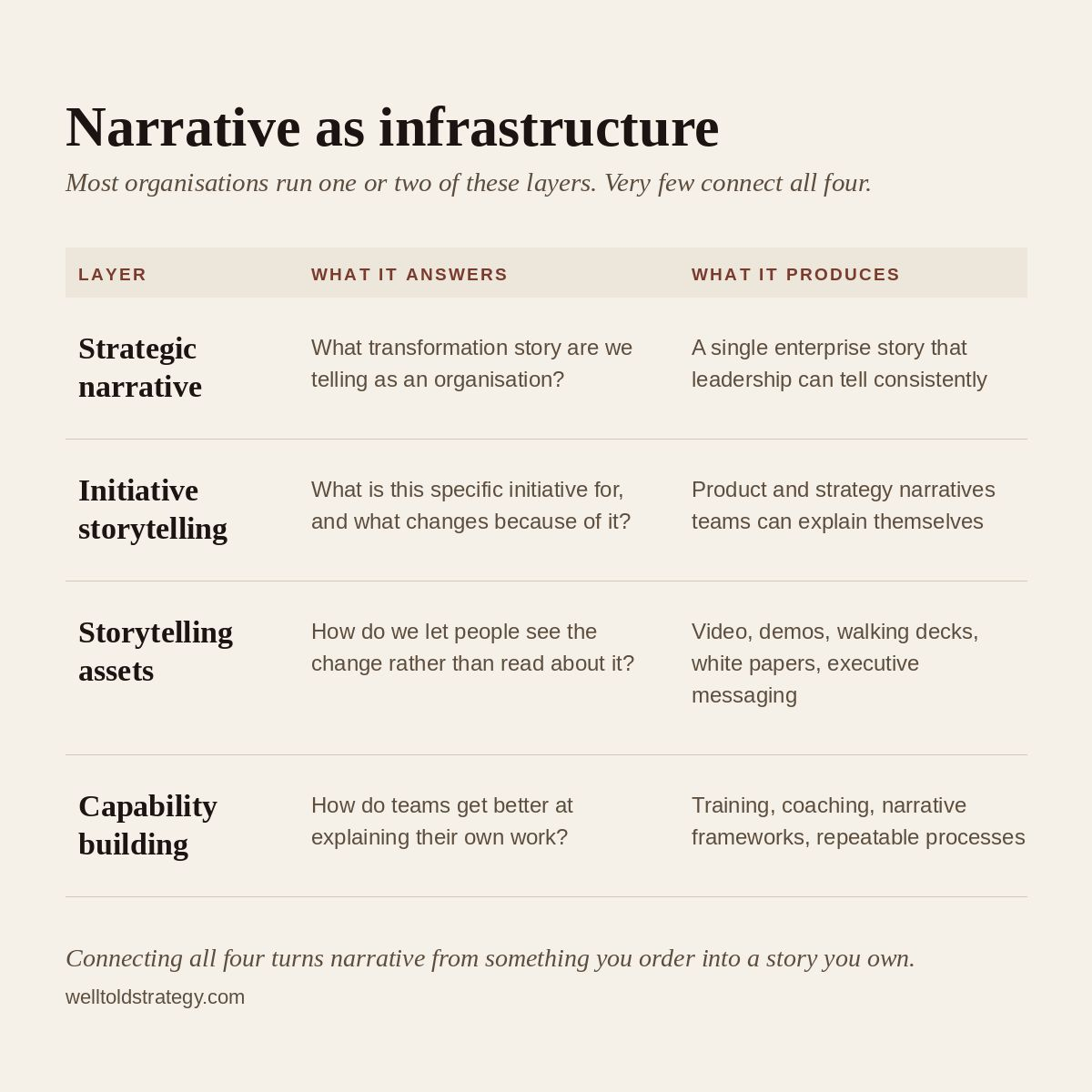
Most organisations run one or two. Communications owns messaging and content, product owns the demos and the decks, and the two rarely meet – which is why the narrative ends up reactive, duplicated, and slightly different every time someone asks for it. Connecting all four is what turns it from something you order into a story you own.